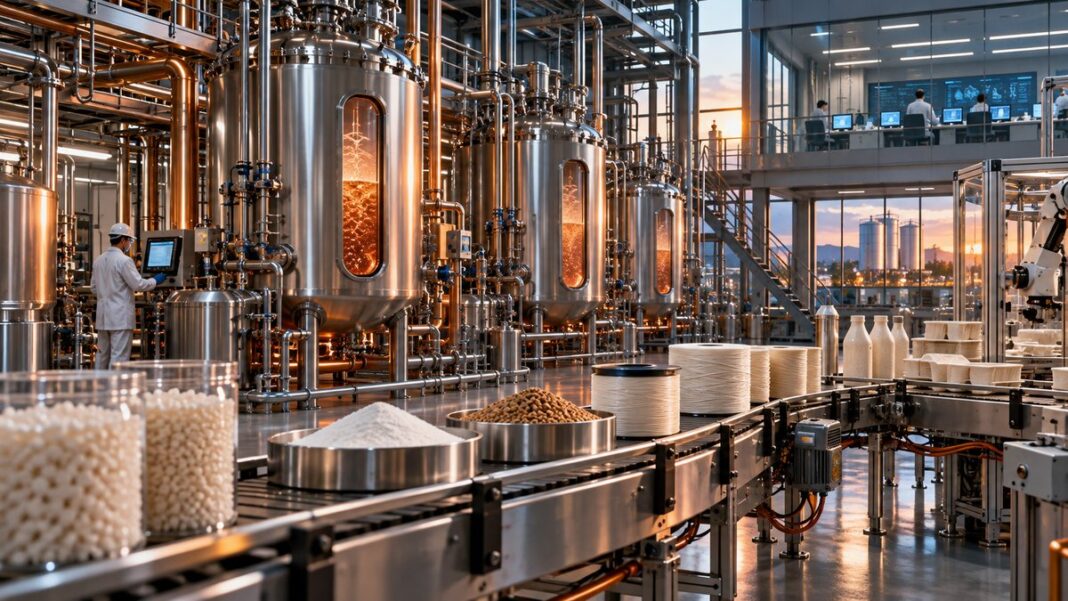

Biofabrication uses cells, enzymes and other biological systems to make useful materials and products. It can support lower-carbon chemicals, fibres, food ingredients and medicines. However, its environmental value depends on energy, feedstocks, scale and end-of-life impacts.

What is biofabrication?
Biofabrication applies biology to production. A company may use microbes to ferment a chemical, grow a material or assemble a complex molecule. In this way, living systems act as small factories.
The term also covers techniques such as tissue printing and cell-based material design. Therefore, its meaning depends on the industry. In manufacturing, the core idea is to use biological processes to create a useful output.
How synthetic biology supports manufacturing
Synthetic biology helps teams design or modify biological pathways. Researchers can select genes, tune production conditions and test how an organism performs. As a result, they can improve yield, quality or consistency.
These tools work best through repeated cycles of design, building and testing. Computer models can guide choices, but laboratory evidence remains essential. Our guide to AI in biology explains how data tools can support this process.
Biofabrication for chemicals and materials
Microbial fermentation can produce enzymes, flavours, polymers and chemical ingredients. Some processes use sugar or plant matter as feedstock. Others aim to use waste gases or industrial by-products.
Consequently, biofabrication may reduce dependence on petroleum in selected products. Yet a renewable input does not guarantee low emissions. Producers must count farming, transport, electricity, purification and waste treatment.
Precision fermentation and industrial scale
Precision fermentation uses selected microorganisms to make a defined product. Teams grow the organism in controlled vessels and then recover the target material. This approach is already familiar in pharmaceuticals and industrial biotechnology.
Scaling remains difficult because conditions change inside larger equipment. Mixing, oxygen and temperature can vary across a vessel. Therefore, a process that works in a small laboratory may need major redesign at commercial scale.
Bioprinting and living materials
Bioprinting places cells or biological materials in controlled patterns. It is best known for research in tissues and regenerative medicine. Read our detailed overview of bioprinting technology.
Manufacturing applications may also include living or responsive materials. However, these products raise special questions about stability, containment and storage. Teams must define how the material behaves throughout its useful life.
Measuring sustainability in biofabrication
A credible sustainability claim needs a life-cycle assessment. The assessment should compare the biological process with a realistic alternative. It should also cover direct emissions, electricity, water, land and final disposal.
The US Department of Energy’s industrial decarbonization resources show why manufacturing emissions must be viewed as a system. Efficiency gains matter, but so do heat sources and supply chains.
Safety, ethics and regulation
Biofabrication facilities may use engineered organisms. Therefore, operators need containment, monitoring and waste controls. Product safety rules also vary between chemicals, food, medicine and consumer materials.
Ethical questions include worker safety, community impacts and access to technology. In addition, companies should avoid broad claims that a product is green without evidence. Transparent methods and independent review build trust.
A practical path to commercial use
Start with a product that offers a clear advantage. Next, test the full process rather than only biological yield. Then measure cost, resource use and emissions at each scale.
Biofabrication will not replace every conventional factory. Still, it can improve selected products where biology offers a genuine performance or sustainability benefit. The strongest projects combine sound engineering, reliable economics and measurable environmental results.