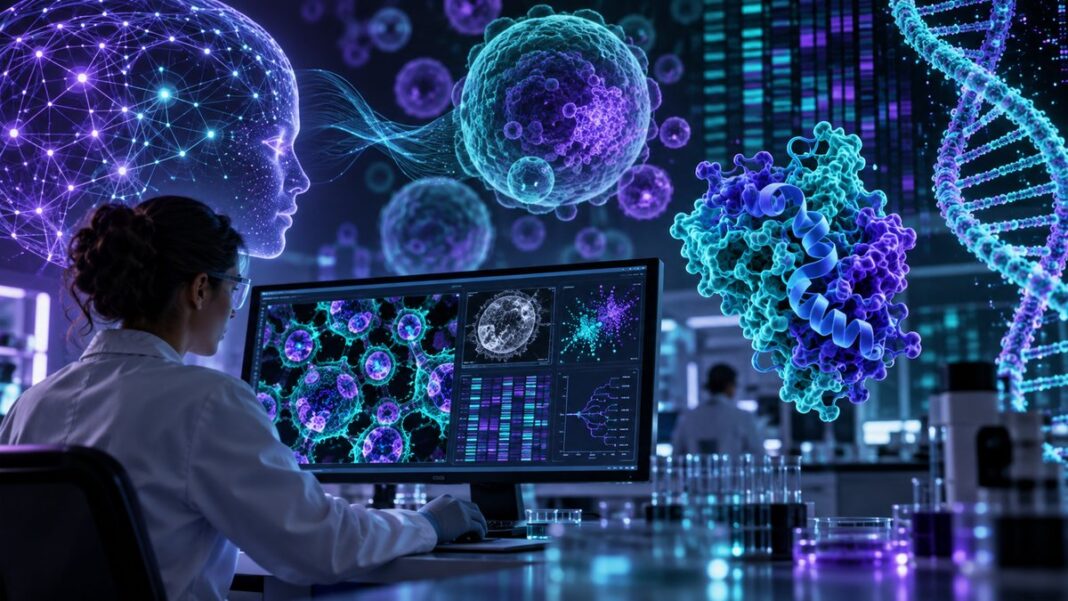

AI in biology helps researchers interpret complex data, test ideas faster and identify useful patterns. Machine learning can support work across genomes, proteins, images and clinical records. However, these systems still need reliable data and expert review.
What AI in biology means
Biology produces large and varied datasets. For example, a single project may combine DNA sequences, protein structures, microscope images and patient observations. Machine learning finds relationships within this information.
These models do not replace laboratory science. Instead, they help researchers select promising experiments. As a result, teams can focus time and resources on the strongest candidates.
AI in biology for drug discovery
Drug discovery begins with a search for biological targets and useful compounds. Machine learning can rank molecules, predict selected properties and compare experimental results. Therefore, it can narrow a large search space before laboratory testing begins.
Still, a prediction is not proof that a medicine is safe or effective. Researchers must validate each candidate through experiments and clinical studies. The US Food and Drug Administration explains how AI is considered in medical-product development.
Genome analysis and variant interpretation
In AI in biology, sequencing tools read the order of bases in DNA. Machine learning then helps identify variants and estimate which ones may affect biological function. Consequently, researchers can study links between genetic changes and disease.
Good reference data is essential. If a dataset underrepresents a population, the model may perform poorly for that group. Thus, diverse datasets and transparent validation are central to responsible genomic analysis.
Protein structure and biological design
For AI in biology, proteins fold into shapes that influence how they work. AI systems can predict aspects of those structures and help researchers compare possible interactions. This capability supports basic science as well as early drug research.
Scientists also use computational tools to design biological parts. For example, they may compare sequences before building a genetic construct. Our guide to Biopython for bioinformatics explains one widely used software toolkit.
Medical imaging and disease detection
In AI in biology, machine learning can analyse images from radiology, pathology and microscopy. It may highlight regions that deserve attention or help measure changes over time. In practice, this can support a clinician or researcher during review.
However, performance can change across hospitals, scanners and patient groups. A model must be tested in the setting where people will use it. Human oversight also remains important, especially when a decision affects patient care.
Personalised medicine and treatment selection
AI in biology can combine molecular and clinical data to support treatment research. For instance, a model may group patients with similar disease features. Researchers can then test whether those groups respond differently to a therapy.
AI in biology uses sensitive health and genomic data, so privacy, consent and security matter. Moreover, an accurate model may still be unfair if access to testing or treatment is unequal. Responsible use must address both technical performance and real-world delivery.
AI in synthetic biology
Synthetic biology teams design organisms for practical tasks. Machine learning can help them compare DNA sequences, predict biological behaviour and choose experiments. This approach may support work in medicine, farming and biomanufacturing.
Yet AI in biology deals with complex living systems. A design that works in software may behave differently inside a cell or at industrial scale. Therefore, teams need iterative testing, measurement and safety review.
How to evaluate AI in biology
Start with the scientific question, not the model. Next, check whether the training data represents the intended use. Then compare predictions with an appropriate baseline and independent test set.
Finally, document uncertainty and keep experts involved in decisions. AI in biology is most valuable when it strengthens scientific judgment. Used carefully, it can speed discovery while keeping evidence, safety and human responsibility at the centre.