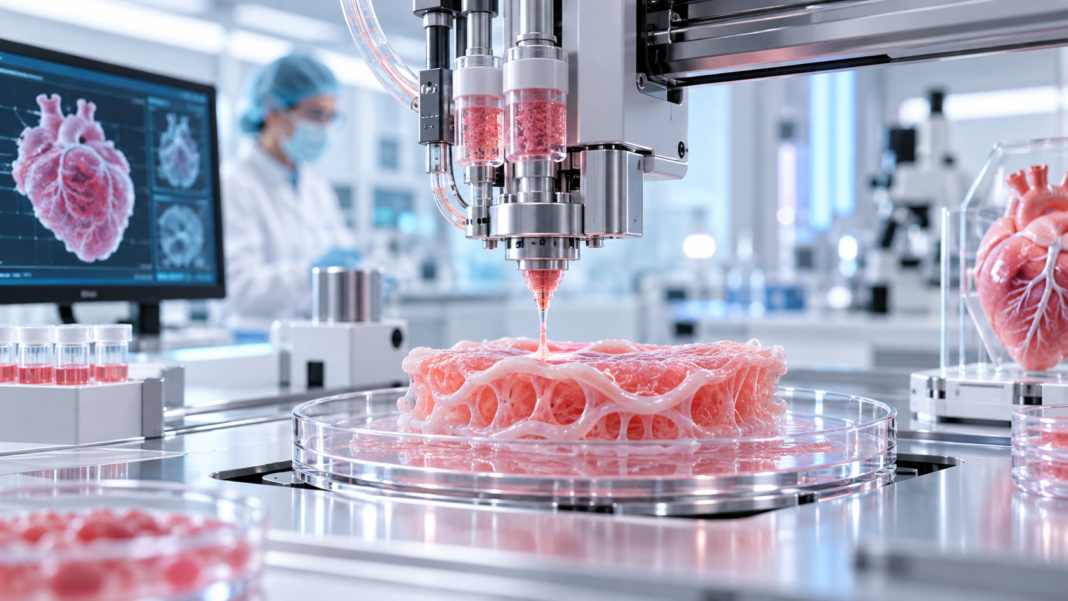

Bioprinting uses controlled printing methods to place cells and biomaterials in three-dimensional patterns. Researchers use it to build tissue models, test medicines and study regenerative medicine. However, printing a complete transplantable organ remains a major scientific challenge.

What is bioprinting?
Bioprinting combines 3D printing with cell biology and materials science. A printer deposits a bioink according to a digital design. The bioink may contain living cells, a supportive material or both.
After printing, the structure needs suitable conditions to mature. Cells require oxygen, nutrients and biochemical signals. Therefore, printing is only one part of a longer tissue-engineering process.
How the bioprinting process works
Researchers first define the shape and purpose of the tissue model. Next, they choose cells and a material that supports those cells. Then the printer places the material through extrusion, droplets or another controlled method.
The printed construct may enter an incubator or bioreactor. Scientists then measure cell survival, structure and function. In practice, each stage requires careful calibration and quality control.
Bioinks and living cells
A bioink must be printable while protecting the cells. It may use natural materials, synthetic polymers or a mixture. The material should also allow nutrients and signals to move through the structure.
No single bioink suits every tissue. Skin, cartilage and liver models have different needs. As a result, teams design the material around one specific application.
Bioprinting in regenerative medicine
Regenerative medicine aims to repair or replace damaged cells and tissues. Bioprinting can create research models with controlled shapes and cell arrangements. These models may help scientists study how tissues form or heal.
For example, clinical use is more demanding. A thick tissue needs blood vessels to deliver oxygen and remove waste. It must also integrate safely with the body. The US National Institute of Biomedical Imaging and Bioengineering explains tissue engineering and regenerative medicine.
Drug testing and disease models
Bioprinting can create small tissue models for laboratory testing. Researchers may use them to compare how cells respond to a drug. Consequently, these models can add useful biological context to early research.
Still, a printed model does not reproduce the whole human body. Results must be interpreted alongside other laboratory and clinical evidence. Regulators also need validated methods before data can support a medical decision.
Personalised tissue research
Some projects use patient-derived cells to build disease models. This approach may help researchers examine why people respond differently to treatment. It may also support studies of rare conditions.
However, personalised models raise questions about cost, consent and privacy. Cell quality can vary, and production must remain consistent. Therefore, research value does not automatically translate into routine clinical use.
Bioprinting and synthetic biology
Synthetic biology may help researchers control how cells behave inside a printed structure. For example, engineered cells could respond to signals or produce selected molecules. This combination could support more functional tissue models.
Yet added complexity creates added risk. Teams need containment, genetic stability and safety testing. Our guide to biofabrication in manufacturing describes related scale and governance questions.
Technical and ethical challenges
Major technical barriers include vascularisation, cell survival and long-term function. Reproducibility is also essential. A tissue model must perform consistently across batches and laboratories.
Ethical issues include cell sources, informed consent and fair access. In addition, public claims should distinguish research models from approved therapies. Clear language helps patients understand what the technology can and cannot do.
The future of bioprinting
Near-term progress is likely to come from better tissue models, bioinks and research tools. These uses can improve experiments without requiring a complete organ. Meanwhile, advances in imaging and cell culture may make printed structures more realistic.
Bioprinting is promising, but it is not a shortcut to organ replacement. Progress depends on biology, engineering, manufacturing and regulation moving together. Careful validation will determine which applications deliver real clinical value.